The Museum of Mediterranean Masks in Mamoiada was born from an initiative of a group of young people who returned to Mamoiada after their studies. Together they aspired to enhance the traditional Mediterranean masks with particular attention to the Sardinian masks, of which Mamoiada is one of the best known examples.
The museum quickly established itself among the most dynamic local realities and today welcomes a growing number of tourists. Its founders and some collaborators accompany visitors to discover the traditional masks and the popular processions in which they are worn.
the challenge
The museum welcomes a growing number of foreign tourists coming mainly from France but also from Germany and other countries. To offer them a better service, they decide to create an audioguide in their language to be downloaded on mobile devices provided by the museum and made available for free to the visitors.
After several unsuccessful searches of IT service companies, without specific experience in the field of tourism applications and multimedia tour-guides and with very high prices compared to the real possibilities of the museum, they found in Blue Lion Guides a fitting partner who combined the technical skills and cultural sensitivity necessary to accompany the project.
the solution
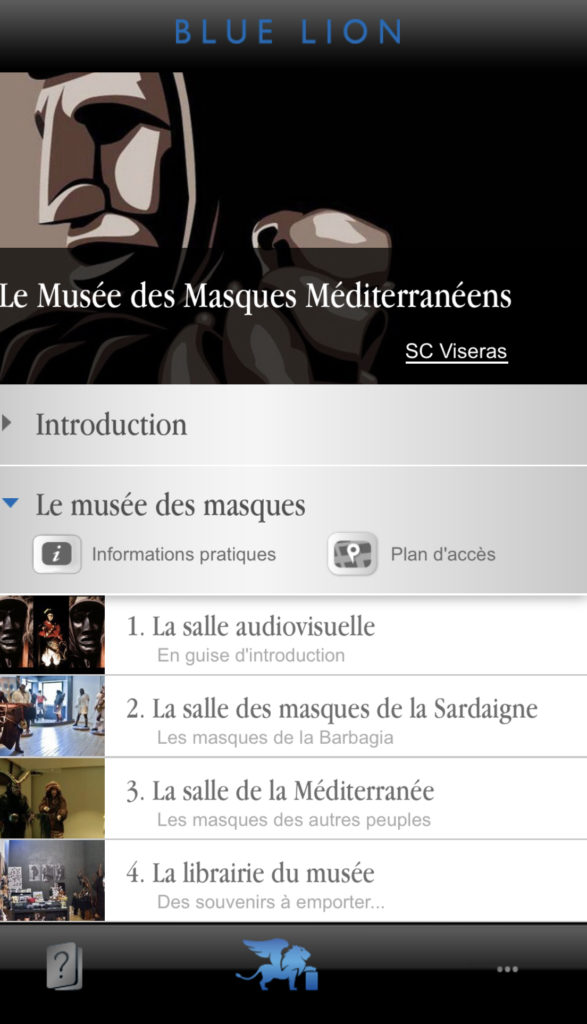
The museum sent Blue Lion a first version of the guide text along with some photos of the masks on display. Blue Lion examined the material and advised to expand certain sections to enrich the visitor’s interest and add images of traditional mask parades in other Mediterranean countries. The joint work, Blue Lion participated in the research and also in the edition and expansion of the text, culminated in a complete version of the guide in French, which was later recorded in audio by a French actor.
The feedback was very positive: many tourists were amazed to see that a museum in a small town had created an application for them and there was much praise for the quality of the application and the content offered. Following these comments, an English and a German version followed soon.
The Future
Today, Blue Lion and the Mamoiada Museum are working on a new version of the multimedia guide to enhance the visitors’ experience and update it with the new masques on show.
The new guide will be available both on the Web and on the visitors’ devices, allowing them to enjoy the museum collection both onsite and offsite.
Case study: Italy
The current ongoing crisis economic crisis, triggered by the Covid-19 pandemic, could be the most severe since the second world war and may be comparable to the great depression of 1929. At the peak of the first wave, in just a few weeks, unemployment rates all over the world rose by dozens of points and it may take quite a while for the labor market to go back to the pre-covid indexes.
The recreation and culture sectors are among the most affected by the current emergency. The new crisis has hit precisely at a time when it was slowly emerging from a black five-year period that began following the 2008 international financial crisis and lasted until the Italian financial crisis of 2013 with a significant decrease in the resources committed by local administrations and at the same time the contraction of household spending which had fallen by 4.6%. (Annual Report Federculture 2019)
The spending of Italian households in the sector has risen by 13.6% since 2013, settling in 2018 at 6.7% of their total expenditure, a figure which is still lower than that of the European average which stands at 8.5%. An important driving force for the recovery of families is represented by the museum sector and archaeological sites: since 2013 the attendance of museums has increased by 23% (+ 3.4 million visitors) and that of archaeological sites by 33% (+ 3.9 million).
Mindful of the past crisis, and in the light of the consequences of the worldwide epidemic of Coronavirus, the alarm went off for the culture sector with dramatic prospects for companies in the sector. In the light of past experience, it is necessary to analyze its current state and identify potential growth prospects in order to be able to cope with an inevitable decrease in visitors and funding due to the current situation.
The Italian cultural heritage complex boasts about 5000 museums and similar institutions open to the public. In 2018, the all-time high of visitors was reached, exceeding the threshold of 128 million people, a figure that was constantly increasing (L’Italia dei musei, 12/2019 ISTAT). This is a significant number, far higher than those of the rest of Europe (La valorizzazione del patrimonio artistico e culturale in Italia: Confronti internazionali, divari territoriali, problemi e prospettive Beretta, Firpo, Migliardi, Scalise – Questioni di Economia e Finanza, Banca d’Italia 11/2019), a wealth that has an important multiplier effect on the territory but whose potential is not fully exploited and leaves ample room for progress.
The demographic groups
Our country still lags far behind in the ability to attract the attention of various age groups. In 2017, among under 24, the number of those who visited at least one museum or an archaeological site or a monument was below 50% (in France they are more two out of three). And among over-sixty, fewer than one in four attend them at least once a year (Annuario Statistico 2018, ISTAT). In the third age these figures are even more significant, museums and exhibitions are deserted by the over seventy-five year olds, 9 out of 10 stay at home!
Offers differentiated by age group – young people
Speak their language
The creation of itineraries and exhibitions for families and young people and a chance to interact using technology, with audio guides with content suitable for children and the use of multimedia such as visual recognition and interactive gaming will allow whole families to enjoy the visit.
User generated content
The modern word of mouth, in technological jargon “User generated content” (UGC), or the content produced by the users themselves who thus become ambassadors of the museum. This is completely free advertising that has very high satisfaction values and that sees visitors participating and not just considered as passive audiences. Over 90% of consumers trust advice from family and friends more than any other form of advertising, 79% say that advice from acquaintances (UGC) has a significant impact on their purchases. These contents can then be relaunched through awareness and marketing campaigns with extremely positive results.
Differentiated pricing policy
According to the Italian Institute of Statistics (Istat), the absence of differentiated pricing policies is one of the main causes of the expulsion of young people from museums. Ensuring access to the youngest groups is an investment for the future, as consumers of art and culture are loyal customers who will return. Interacting with them on their social channels by offering free access, or discounts for young people or family tickets is a system
Opening hours
In Italy the opening hours of many museums are rigid, greater flexibility, with evening openings for example, would make museums and exhibitions more accessible even to those
Initiatives for the elderly
Although the Covid 19 crisis has been able to break down barriers by regressing the technophobia especially present among elderly people, we must not be fooled and the technological gap remains wide. According to Istat, a reduced confidence with digital communication and information tools remains the main obstacle to the participation of the elderly in cultural life.
Yet the positive impact on the physical and mental health of those who attend museums is known, and in particular for the elderly. Various recent studies have in fact highlighted, if necessary, the beneficial effects of visiting museums. According to a study by the University College of London, published in the British Journal of Psychiatry in December 2018, there is a 32% lower risk of developing depression among people who attend museums and a separate study found a similar correlation for the impact on the dementia rate.
The regenerating potential of museum spaces is therefore extremely topical and it must be exploited to encourage visits by the elderly, an opportunity for social involvement through free or paid activities for small groups, such as mornings reserved for the elderly or wellness activities such as meditation or yoga courses.
Cultural non-participation
Not only various age groups are ignored, but the potential catchment area is much larger considering the percentage of the population that continues to desert museums and archaeological sites. In fact, in Italy the percentage of cultural non-participation is extremely high. In 2017, only 32.5% of Italians have visited museums or exhibitions and 27% have visited an archaeological site or monument at least once. It is one of the European countries with the least cultural participation.
Despite the existence of factors that are beyond the control of the art and culture sector, bringing this audience closer to museums is not impossible. In Italy, the ability to collect data on visitors is still very lacking, but knowing them is the first fundamental step to define a strategy aimed at expanding your user base. The paucity of data collected by the sector is a factor preventing its development. Yet today these are technologies that are easily accessible both through websites and through the development of apps for museum visits. One way to go, especially for small museums, is to create synergies between institutions and share the data collected on a common platform to develop a targeted market strategy that can improve the cultural offer and attract a wider audience.
Engagement through social media
Not only young people can be the object of involvement on social media According to a study conducted by the Arts Council and Nesta in England, over 50% of cultural institutions consider the use of digital technologies useful to reach a wider audience, social media represent a key technology in this field with Facebook and Instagram the favorite channels (Digital Culture 2019, Nesta & Arts Council England). Among the most successful strategies to stimulate the public in this field is the sharing of videos or images and the publication of posts with informative content. The references to the local and territorial context assume greater relevance, enhancing the role of the museum in territorial identity and its cultural wealth (Musei e social media, Calveri e Sacco, Derevworld, 06/2019).
This trend is certainly reinforced by the Covid 19 crisis. In the absence of a material meeting In situ, the online meeting has grown, an encounter that, for 50% of museums, cannot be held due to the lack of a website or a suitable app. The online meeting and the offer of virtual tours or online itineraries can be one of the elements to break down social barriers by bringing those populations who, for economic, cultural, social or “awe” reasons do not cross the thresholds of the museums, art galleries or other heritage sites.
Loyalty
The relationship with the visitor that goes beyond the single visit can also be improved. The visitor increasingly demands a relationship with the museum that develops in three phases, before and during the visit, but also after it, with the request to deepen the knowledge and experience after the meeting on site. Visitor loyalty is an achievable goal by exploiting on the one hand digital technologies and data collected during his first visit and on the other by proposing content that is renewed and complementary activities. Sending newsletters and promoting events, thanks to a database collected from invitations to register on an app or to leave contacts on the website, are excellent ways to interact with the community and involve it.
Technologies of enriched experience and audience engagement
As we have seen, the use of digital technologies is essential to attract new visitors and retain those who have already crossed the threshold of the museums. Since the “first meeting” with the visitor now takes place in the virtual sphere through websites and apps, those who can strengthen and improve their offer in this field will have a comparative advantage. However, the level of interactive technologies adopted by Italian museums is definitely lacking. Less than half provide support for visits such as applications on smartphones, touch screens, multimedia content or augmented reality itineraries, while only 10% offer the possibility of a virtual visit. The online presence also leaves much to be desired with only 50% of museums having their own website and social media accounts. For small establishments the task of creating apps and websites may seem daunting, but in reality they already have many of the necessary skills: the knowledge of one’s own museum heritage together with the passion for the subject matter and the desire to tell it in an interesting and personal way. These are the indispensable ingredients of “storytelling“, the means to engage visitors and make their visit an experience which they will talk about with friends and advertise on their own social networks. The platforms for the creation of apps that can also serve as a website are now accessible to everyone, created with management systems that allow even the novice to use them (user friendly) and thus allowing to overcome the technological obstacle and concentrate instead on creation of quality content.
In addition, the facilities to improve the visitor experience and give him access to their digital services must improve the offer of free Wi-Fi on site.
Online ticketing can also be used to promote the facilities. In fact, although the offer has tripled in the last three years (14% of the structures offered it in 2018), adopting it can be simple and push more people to visit museums by improving their online experience.
The international offer
Among the visitors of the Italian artistic and cultural heritage, the share of foreigners is consistent and constantly increasing: in 2018 they made up almost half of the total (46%), but compared to this number only 53% of museums propose solutions in English to visitors (cards, panels…) and only two-thirds are able to provide explanations in English (this figure then drops drastically for French, German and Spanish).
If the flow of tourism has been canceled due to the Coronavirus crisis, this is a temporary stop and it will be appropriate to prepare for their return, albeit gradually, with an improved offer in this sense. Making multilingual websites and digital guides available as seen above must be a priority. In fact, international competition for cultural tourism will be even stronger and Italy must fill a technological gap that today sees it well behind in this field compared to other European countries.
Crowdfunding
In a scenario in which public funding for Culture has undergone a strong contraction as a consequence of the international financial crisis of 2008, followed by the economic slump of 2013 and where 700 million euros are still missing from public spending in culture (in 2017 the public spending in the sector reached 5 billion and 849 million down from 6 billion and 550 million euros in 2008) and in anticipation of resources that risk being further reduced by the Covid 19 crisis, the museum and heritage sites sector must seek additional sources of financing and income. In fact, even expanding its catchment area, it remains a fact that the revenue from tickets sold generally represents only a marginal portion of the funds needed to preserve and enhance the assets.
If patronage with the institution of the Art Bonus has had positive effects, although above all for large works and museums, small museums must try to leverage tax advantages addressing the local community by focusing on micro-patronage and exploiting crowdfunding platforms such as Kickstarter or Indiegogo, which make it possible to launch campaigns to finance various initiatives in the field of culture and the preservation and enhancement of heritage. By addressing the community close to its museum, it also strengthens the identity by grouping the community around a common project and heritage. Even the creation of museum apps or web sites can be financed in this way, perhaps by offering free visits to the museum or participation in special evenings dedicated to donors.
If the outcome of the pandemic crisis is not yet clear, the key to overcome the emergency faster relies in the capacity of the single actors to attract the attention of the public by varying their offer and radiating their own influence in the surrounding community and beyond their own territory by seizing the opportunities offered by the digital world and social media.
find out more about a digital solution for museums
The echo resounds in the corridors of the closed museums, the animals have regained possession of the parks, the roar of the cars have given way to the sounds of nature. At the heights of the Covid-19 lockdown more than half of the world population shut itself up in their homes, pouring their gaze towards the screens trying to find an answer to a new reality. And if initially the only refuge seemed to be in a television series on Netflix or other similar platforms, humanity quickly realized that on the screen, the only window to the surrounding world that remained accessible, it would have to find other answers.
More than 3 billion people use a smartphone today, a figure that is constantly increasing if you think that 1.4 billion are sold worldwide every year. To these already impressive figure we must add over 1 billion tablets and 1 billion computers.
Infinite pairs of eyes focused on a light source that, if until recently alienated humanity from face-to-face contact, reading and culture by offering content of a flat quality, during the coronavirus crisis has become the greatest companion for many to help them overcome the crisis and loneliness. The digital sphere in general and the telephone in particular, accused of being a factor that will contribute to the depression and loneliness of the human being, have paradoxically become the universal means to overcome them. Even for technophobics, fear has been defeated by the human need to communicate.
And in the acceptance of this addiction, the need to find an answer, not only to more or less pleasant amusements, but also to the needs of the spirit and body, has emerged at the same time. This explains the meteoric success of apps and social media accounts and websites that offer “wellness” activities from meditation to yoga, and at the same time the exponential growth, even higher than that of the spread of the Coronavirus, of the offers by theaters, historical sites, museums and orchestras of online content accessible to all.
This is a formidable opportunity for the actors of the cultural world to occupy a space that has been neglected for a long time. During the month of March this year, the search popularity of topics such as “virtual tour museums” or “streaming theater” or “online museums” went from figures of less than 10% to peaks of 100% (source: Google Trends ).
Even general searches, such as the Berlin Philharmonic, which averaged less than 50% in terms of popularity, have doubled their value thanks to the offer of free streaming of their concerts. If we add the word “streaming” to the same search then the results are even more significant, going from 0% to 100%. The same experiment, with similar results can be repeated with “Egyptian museum” and “Egyptian museum online” or “Vatican museums online”.
This trend was able to be realized thanks to the awareness of their social and educational role on the part of the great cultural actors who responded to their closure by bringing museum spaces and other cultural activities into homes by offering high quality content accessible to all and affirming their presence. also on social networks such as Instagram, Facebook and Twitter where they have found great success thanks to hashtags like #MuseumfromHome, #MuseumBouquet or #Lamusicanonsiferma coined by the Giuseppe Verdi Symphony Orchestra.
This trend was unfortunately very short lived the online offer not having met the expectation, the public has gone back to its old habits.
According to the definition of ICOM (The International Committee of Museums which has 119 member countries) “The museum is a permanent, non-profit institution at the service of society and its development, open to the public, which carries out research on material and immaterial testimonies of man and his environment, acquires them, preserves them, communicates them and specifically exhibits them for purposes of study, education and pleasure “.
A redefinition of this role is currently underway with proposals from the various member countries. The Italian proposal of May 2019 puts forward precisely the role of museums at the service of society:
“The Museum is a permanent, non-profit, accessible institution that operates in a system of relationships at the service of society and its sustainable development. It carries out research on the testimonies of humanity and its cultural landscapes, acquires them, preserves them, communicates them and exhibits them to promote knowledge, critical thinking, participation and the well-being of the community. “
A redefinition of the role of culture is needed also in the digital sphere.
It is certain that after the current pandemic crisis the social role of museums will become even more central. As highlighted in a recent article published in “The Museum Journal” “It is interesting to note that the periods during which the social role of the museum is most discussed correspond to periods of economic crisis or socio-political unrest and conflicts, both in Europe and in Latin America. This was the case in the West after the financial crisis of 2007-08, but it was also the case in the 1970s after the first oil shock, and earlier, in 1930, when articles on the social role of museums.”
Museums are called upon to respond to this new reality and digitization that has come to the fore will be the vector to face this challenge. In a study published in 2017 on digital transformation in the museum industry 86% of museums expressed the belief that the best way to interact with their visitors is inside the museum itself while only 44% emphasize the importance of the sphere online and social media and only 7% are satisfied with their apps developed to interact with visitors.
Digitization cannot be limited to making its collections accessible online but must offer the conditions and means to ensure a sustainable future and the validity of museums for future generations as well. Today a holistic approach is needed in which the different roles of the museum spaces must support each other by extending the interaction with the community well beyond the moment of the visit. Technology is the medium through which this goal can be achieved by creating a permanent communication channel with the community.
Find out more on how to reach out to your audiences
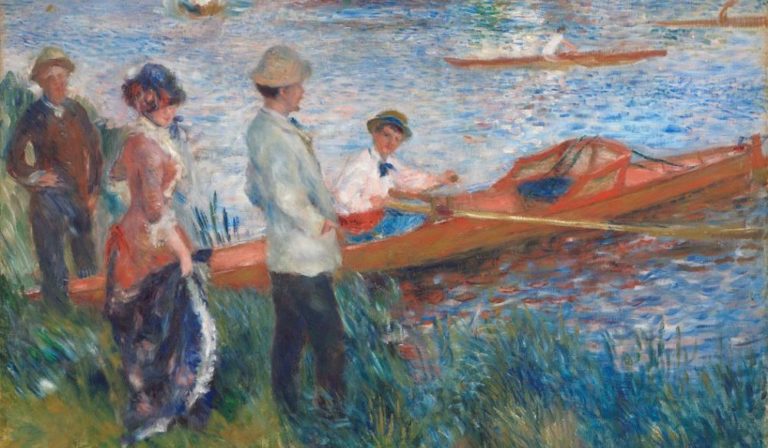
The city of Chatou is well known for being one of the hotspots of the impressionist and fauvist painters. In the outskirts of Paris, from which the oldest French passenger train line could reach it, the small city on the banks of the river Seine, was a bucolic and pleasant recreational spot for the rich and famous of the 19th and early 20th century.
the challenge
The city council has been actively promoting the heritage of Chatou with the aim of offering its residents and visitors a historic and cultural perspective of their city and a good reason to walk around and discover lesser known spots and stories. While several paper guides were published by local historians and a number of educational panels have been placed in several areas of the city, nothing was available in the form of online apps or web sites.
The Solution
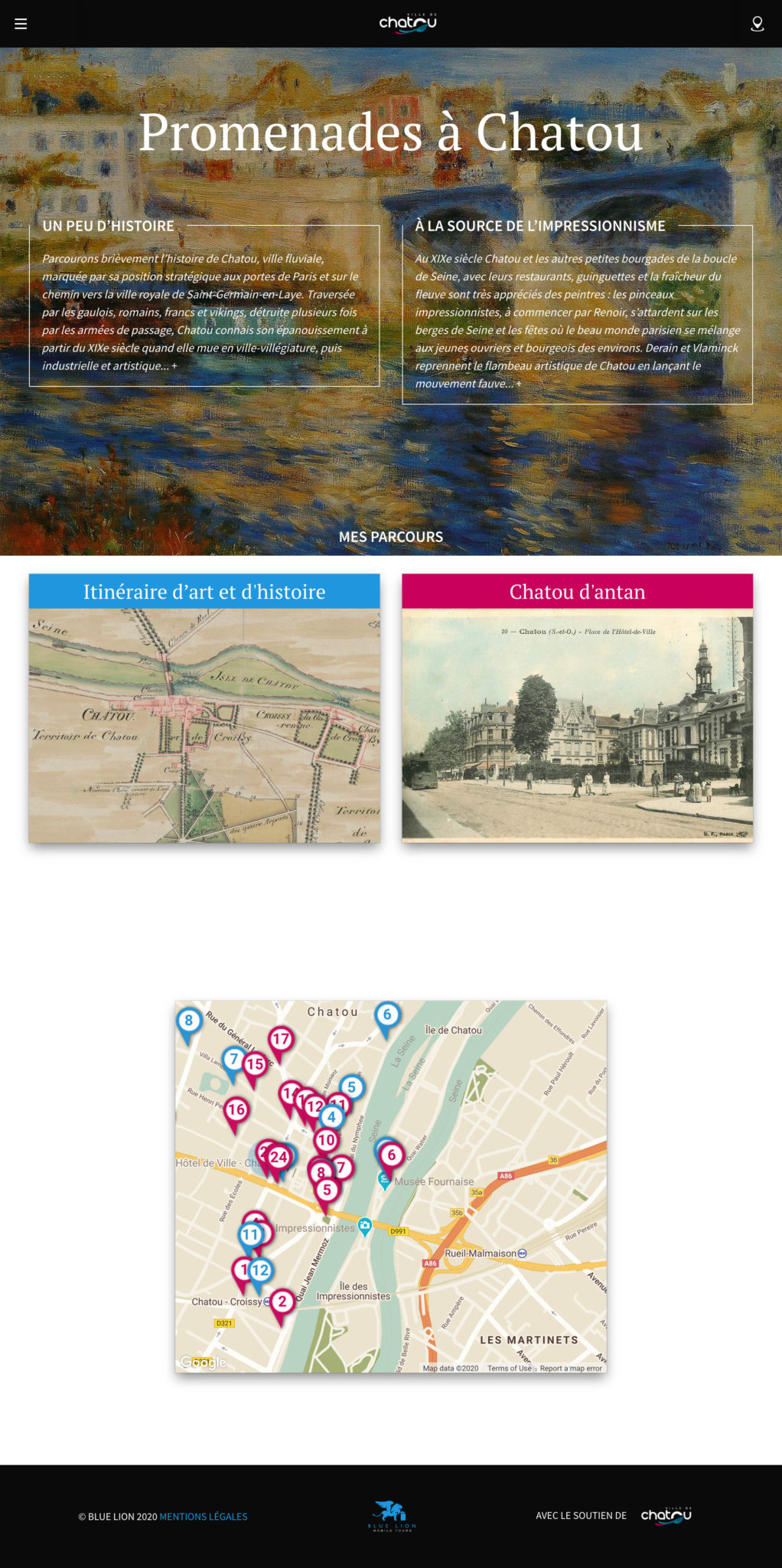
Blue Lion created a platform for setting up walking tours in the city’s area with interactive maps, descriptions, and audioguides. Blue Lion also realized the first two guides for the city of Chatou by writing the texts, recording the audio descriptions, and preparing the media, including photographs and ancient postcards. The guides went live in September 2020.
Residents and visitors have expressed a strong appreciation for the before/after images shown in the second itinerary: a slider on top of a current photo reveals the postal cards of the same spot.
Check the guide at promenades.chatou.fr.
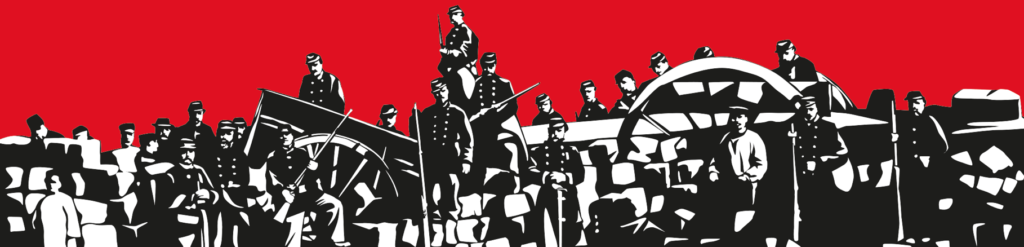
The year 2021 marks the 150th anniversary of the Parisian Commune, a historic event by which the local population took over the reins of the city after the defeat of the French army during the Franco-Prussian war of 1870. The revolutionary uprising started in March 1871 and lasted only a few months until it was crushed in a bloodshed by the French army in May 1871.
the challenge
The upcoming anniversary is little known by youngsters: the public who has shown interest in the history of the French Commune is mostly composed by elderly people. The association “Les Ami(e)s de la Commune”, which is promoting the remembrance of the historic event, wants to approach a younger public on the occasion of the celebrations.
The Solution
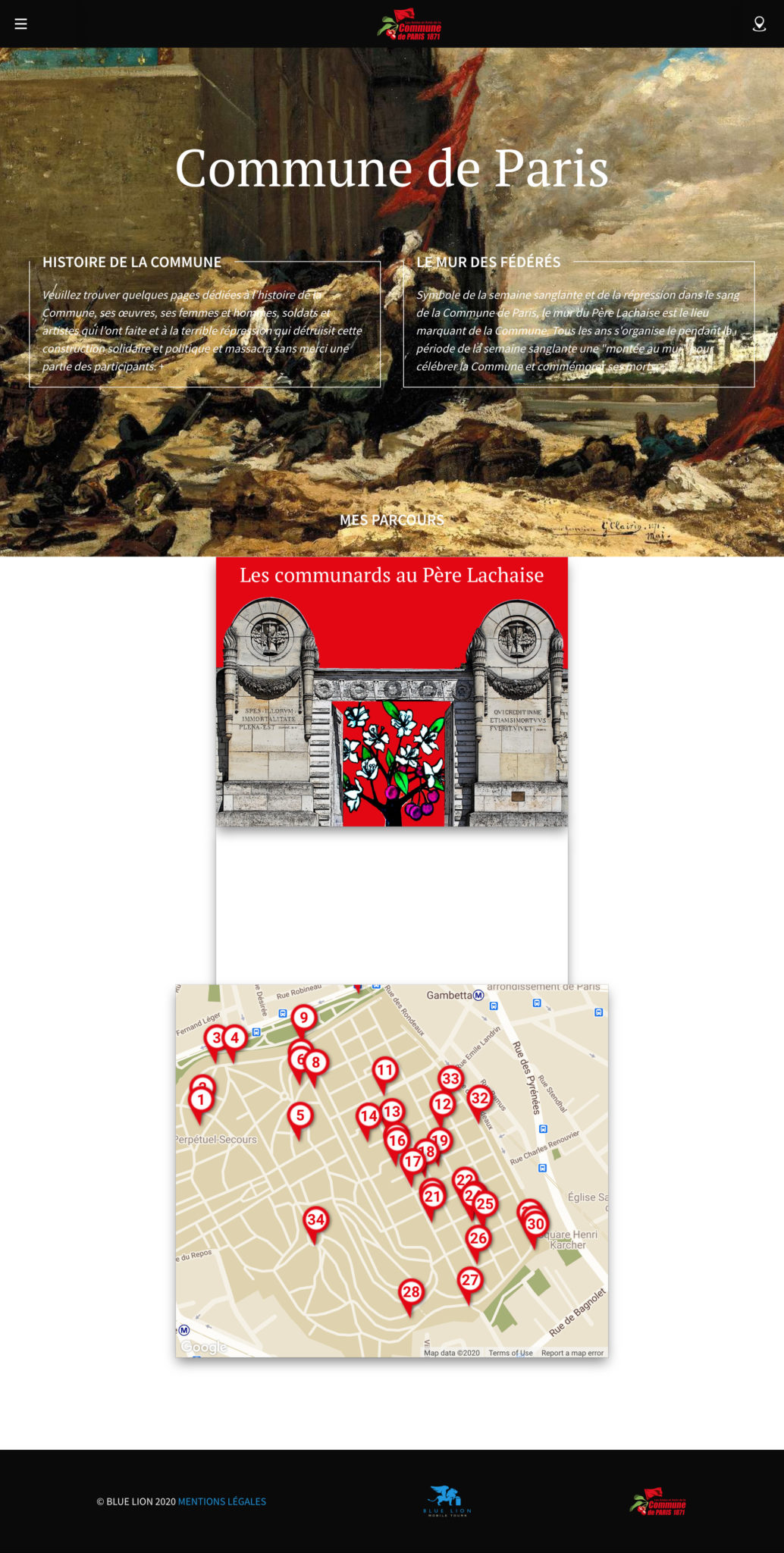
Blue Lion was hired by the association to set up a guide of the Père Lachaise Cemetery in Paris, which was the spot of the latest battles of the Parisian Commune and the burial site of most of its leaders.
The tombs of the communards are spread across the vast cemetery, making it complex to locate them precisely. Blue Lion provided exact geolocation data, researched the iconography of the communard leaders buried there, and carried out photographic documentation of the tombs. The association completed the text and recording.
The guide is scheduled to go live in autumn 2020.
We wrote this article in 2016, after visiting some small museums in Italy and attending a conference organised by their association in Viterbo. Our aim was to ponder about the role of museums and the use of technology. Today, the need to do so is even more stringent and we have started in 2020 to work on a different approach and technology to our guides. We will come back on this topic in the coming weeks. Meanwhile here are some of our thoughts following our tours in Italy.
One of the questione which have followed us from the beginning of our project was: are we sure that we are proposing something innovative and useful and not a refined but obsolete model?
Listening to some participants to the meeting if small museums in Viterbo the impression is that to a certain extent top down guides, like audio guides or written guides do have their limits in terms of raising interest and ensuring appropriation of the museums offering by the public.
For sure, the guides can be very well done, with well written texts, gorgeous images, and a beautiful natural voice who reads them, plus interactive maps and other nice features, but the characteristics is always the same: one direction, from the expert author to the visitor.
It is clear that the main objective of any museum is to raise interest and passion by the local community which should be involved in its life and consider it it’s own (not in the sense of private property) cultural heritage. It should also become a significant and enriching moment in the life of its visitors. These are the challenges ahead.
How to attain these objectives? Only by reaching out to the external world, whether the local community or the occasional (or non) visitor. They should live the museum and be related to its objects and history.
Of course one way of raising interest is to use appropriate technological tools such as a web site to provide the needed information to the visitors and written or audio guides to guide them through the collections. But technology is only a tool and becomes ineffective if the museum is not able to convey its message and put everything else in place to offer a rich experience to its visitors.
We had a telling experience just in Italy with small museums in Italy, in Fabriano to be precise. One was the visit to the museum of the piano, a small museum created by local musicians who run the musical academy who have a passion to collect and show ancient pianos. The setting was just unbeleavable: we arrived with our kids and other family members and were received by the curator and director. He took the time to show us through the collection and actually play some pieces on some of them by composers who had used a piano by the same manufacturers. We even were shown into the room where a Bösendorfer piano was being restored. This was one of the best experiences we ever had in a museum, of course a small museum. Not surprisingly the museum received the highest marks and certificate if excellence, for what it is worth, and we believe in this case it is, on tripadvisor. Please visit the museum here: Accademia dei Musici
The other experience was quite the opposite. Everyone knows how important Fabriano is in the world of paper. Many artists and printers have used Fabriano paper. We could literarily say that the city grew on paper. Of course such a terrific history requires a museum. And of course, being curious about the story of paper in Fabriano we went to see it. I wish we had not. The experience was appalling: first we were shown ans abandoned in a conference room to watch a ridiculous video by, presumably, a sponsor of the museum. The video was just horrible, of no interest whatsoever and lasted 15 minutes! After this knockoff experience the museum guide showed us through the museum. OMG, this was even worse: the visit was done like a reality show: visitors, often young people, were asked to participate to some activities or respond to some questions. The guide had become a low grade Tv host and animator. And on top of this he made continuous and unrelated jokes on Italian politics, something of zero interest for most of his visitors. Needless to say, we quit the tour.
What lessons from these two visits? What was the secret for an enriching vs an appalling visit? The people and their passion and pride for what they are doing certainly. But not only, their consideration for their visitors, not a troupe of, with all respect, of cows to move from one pasture to another, but people with whom to share your passion and who can actually enrich you as well. Without such an openness and ability to relate to the others, it won’t work and a museum becomes, as it was rightly said today, at best a deposit.
So, now let us get back to our main topic: can we enhance the museum guides and how? What is their role? I believe they do have a role, after all it is one way of sharing knowledge and passion. Sure. But the temptation to instruct and patronize our readers is just behind the corner. Before we consider anything else, we should think about the content we are offering. How is it written? Does it sound interesting or it looks like a collection of infos and data by the author. What is the author conveying? A proof of his/her fantastic science or a passion for her subject? If the text is uninteresting then the authors has not been able to relate to his readers. A well written guide is a starting point. But it is not sufficient if the museum aims at involving its visitors. They will like it and learn something. But it will still be a one-direction stream. How can we make it go both ways? This is the question and we hope we will find some answers. Stay tuned!